Product

Lead Scoring vs. Account Scoring: Why B2B Sales Teams Are Rethinking MQLs

Sales stopped trusting MQLs because a high score almost never meant a real opportunity. See how Octane11's F.I.R.E. Score changes the conversation by ranking the account instead of the person.

August 5, 2026
11 min read
Fit · Intent · Recency · Engagement
87%
of MQLs never become SQLsMost-cited benchmark; the unit is the problem
6 to 10
buyers per dealGartner's median buying group; a single score tracks only one
46–57%
of closed-won deals had an organic search touchOctane11 data, 400M B2B sessions; no form fill required
+26%
lift in attributed sessionsThe "direct" bucket was hiding real intent from the full buying group
What the F.I.R.E. Score is

The F.I.R.E. Score is Octane11's account-level score, from 0 to 100, that ranks how ready an account is to buy based on four inputs: Fit, Intent, Recency, and Engagement. It updates as new signals come in, so an account's score reflects what the whole buying group is doing right now, not the point total one lead left behind months ago.

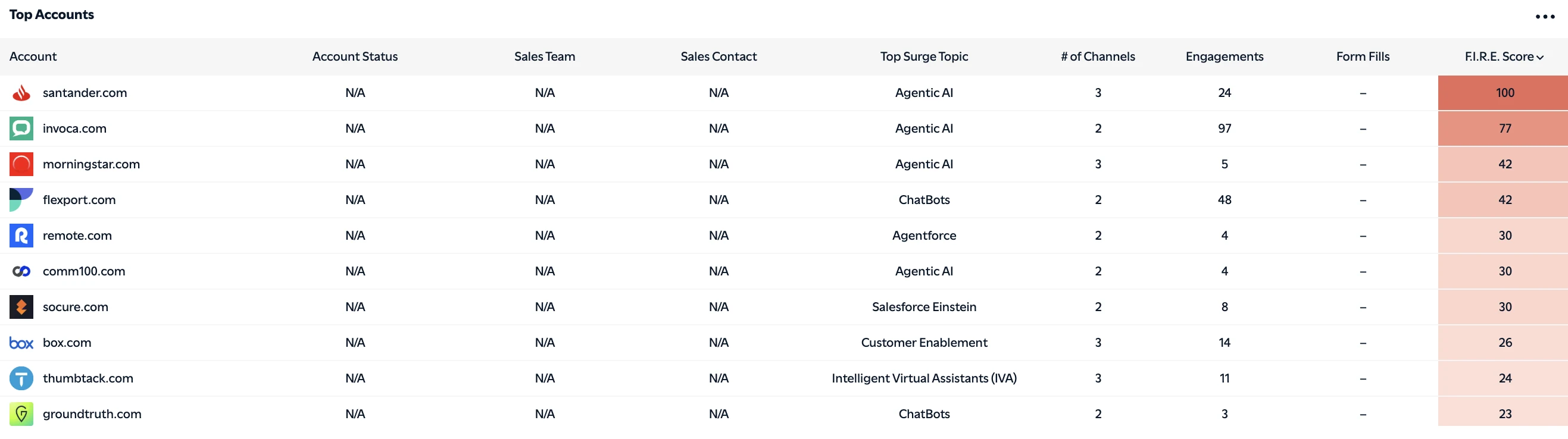
Octane11 Top Accounts view listing accounts ranked by F.I.R.E. Score from 0 to 100, with each account's top intent topic, number of channels, and engagements shown alongside the score
Ranked by F.I.R.E. Score: every target account scored 0 to 100 and sorted by readiness to buy, with the top intent topic, channels, and engagements behind each number.
← Back to Insights

Why lead scoring fails B2B sales teams

Ask a B2B sales team what they think of the MQL list and you'll get a shrug. They stopped trusting it a long time ago, because the score rarely survived the translation to an actual account. A prospect downloads a whitepaper, sits through a webinar, clicks a few nurture emails, and the model hands all of it a 90 and a sales-ready badge. None of it means the account is actually looking to buy.

The gap

By the most commonly cited benchmark, roughly 87 percent of MQLs never become sales-qualified leads. Published MQL-to-SQL rates vary widely enough to treat the exact figure as directional, but nobody in a pipeline meeting argues about which way it points. The gap comes from a measurement problem: lead scoring ranks individual activity, not accounts that are actually in-market.

That gap eventually becomes an executive problem, whether you're running the program in-house or managing it for a client roster. When the board, or the client, asks how much pipeline marketing generated, and sales says the leads handed over never turned into real conversations, the response is rarely a data question. It's a trust question, and it starts with a scoring model that never reflected reality in the first place. It's the same measurement gap that shows up when attribution reporting can explain clicks but not accounts.

Most lead scoring models work the same way. Assign points to actions, add them up, set a threshold. Email open, five points. Pricing page visit, fifteen points. Cross 70 points and marketing hands the lead to sales. The logic feels reasonable until you notice what it's missing: those points almost never decay, and they rarely account for the fact that a single buying decision involves six to ten people, not one.

Here's the part worth sitting with before you touch a single threshold. The problem isn't the tool you bought or the points you assigned. It's the unit you're measuring. You're scoring one person's actions, when the thing actually deciding whether to buy is a committee. Fix the unit and most of the other complaints about lead quality quietly go away.

Lead scoring vs. account scoring
Lead scoring Account scoring
What it measures One person's actions. Every buyer at the account, rolled into a single score.
How signal ages Points rarely expire, so the score keeps rewarding behavior that stopped months ago. Weighted toward recent activity, so accounts that go quiet slide down on their own.
Buying-group coverage Tracks one contact out of six to ten, with no way to connect them. Sees the whole committee, across every channel it touched.
Anonymous and organic research Invisible until someone fills in a form. Resolved to named accounts and scored like any other engagement.
What sales receives A list of leads sorted by past activity. A ranked account list, with the reason each account is on it.
From our own platform data

There's a second blind spot, and a lead model structurally cannot see it. Much of a buying group's research now happens in the open, through organic and AI search, before anyone fills in a form or clicks a paid ad. On our own platform we have watched organic research carry as much of an account's score as any single paid channel in the plan. We call it the organic blind spot, and scoring it is what the rest of this piece is about.
The buying group problem lead scoring can't see

Gartner's buyer-enablement research on complex B2B purchases puts the median buying group at six to ten decision makers, each arriving with four to five pieces of independently gathered research.

A lead score tracks one of those people. It has no view of the other five to nine, and no way to tell that a website visit from someone in finance and a demo request from someone in IT belong to the same evaluation. The individual lead score can look completely cold while the account underneath it is actively moving through a buying process.

The decay problem compounds this. Once a lead earns points, those points typically stay on the record indefinitely. A prospect who opened five emails eight months ago and went silent still outranks an account that started researching last week and hasn't hit the email-open threshold yet. The score measures history, not current behavior. Sales ends up working a queue sorted by past activity instead of present intent.

Why sales stops trusting the queue

In MarketingSherpa's B2B benchmark survey, 61 percent of marketers sent sales every lead they generated with no qualification screening, while only about 27 percent of leads wanted a sales conversation at the moment they converted. That survey dates to 2011, and the habit has outlived it.

The other issue is where that six-to-ten-person buying group actually spends its time. Gartner found B2B buyers spend just 17 percent of their total buying time meeting with all potential suppliers combined, and when they're comparing several vendors, as little as 5 to 6 percent with any one sales rep. The rest is self-directed: reading, comparing, asking ChatGPT or Perplexity to summarize a category, building a shortlist before anyone picks up the phone. McKinsey's 2024 B2B Pulse survey found buyers now use an average of ten channels across their buying journey, up from five in 2016. Very little of that shows up as a scoring event in a traditional lead model, and almost none of it comes with a form fill attached.

Where it breaks down

Lead scoring assumes buying intent shows up as a trackable action taken by one identified person: a click, a form, a reply. Modern B2B buying intent mostly shows up as anonymous research spread across a buying committee, much of it happening before anyone on that committee is willing to identify themselves to a vendor. A model that only counts identified, individual actions is scoring a small and shrinking slice of what's actually happening at the account.

Where your scoring sits today

Most B2B teams fall into one of three stages of scoring maturity. Find the row that sounds like your last pipeline meeting, then look at what the stage after it does differently.

Three stages of scoring maturity
Stage How you score What it looks like
1. Lead scoring Points on one person's actions, added up to a threshold, rarely decaying. Sales quietly ignores the MQL list and works its own accounts instead.
2. Lead scoring plus a rollup An account view bolted on, but scoring still triggers on individual leads, and intent data sits in a tab nobody opens. You have the signals, just not in one number anyone trusts or acts on.
3. Account scoring One account-level score across every buyer and channel, weighted toward recent behavior, including anonymous and organic research. Sales works a ranked account list on a weekly cadence and knows why each account is on it.

Almost no one starts at stage three. The point of naming the stages is not the label, it's the gap between where a team sits and what the next stage would let sales do on Monday morning. Most of the teams we work with arrive at stage two: the data exists somewhere, but no single score reflects the account, so the pipeline conversation still runs on individual leads.

F.I.R.E. Score: scoring the account instead of the person

The fix isn't a better point system for leads. It's scoring the account instead of the person, and building that score from signals that reflect how buying groups actually behave.

That's the logic behind Octane11's F.I.R.E. Score: a dynamic, 0–100 score built from Fit, Intent, Recency, and Engagement, calculated at the account level and updated as new signal comes in, rather than frozen at whatever point total a lead form last recorded.

F

Fit

Measures whether the account matches your ICP in the first place: industry, company size, the basics that decide whether it's worth prioritizing at all, regardless of activity.

I

Intent

Brings in third-party intent data, which tracks whether an account's content consumption on a topic is spiking relative to its own baseline. High-intent topics show up on the account record, so sales sees exactly which topic triggered the signal.

R

Recency

Weights the score toward recent behavior, so an account that researched last week outranks one that earned points eight months ago and went quiet. The number reflects what the buying group is doing now, not activity that never decays.

E

Engagement

First-party behavior at the named-account level: how many members of the buying group engaged, and across how many channels, including the organic and AI-referred website traffic traditional lead scoring has always missed. A lead score only ever tracks one identified person, so this account-wide view is what it structurally can't capture.

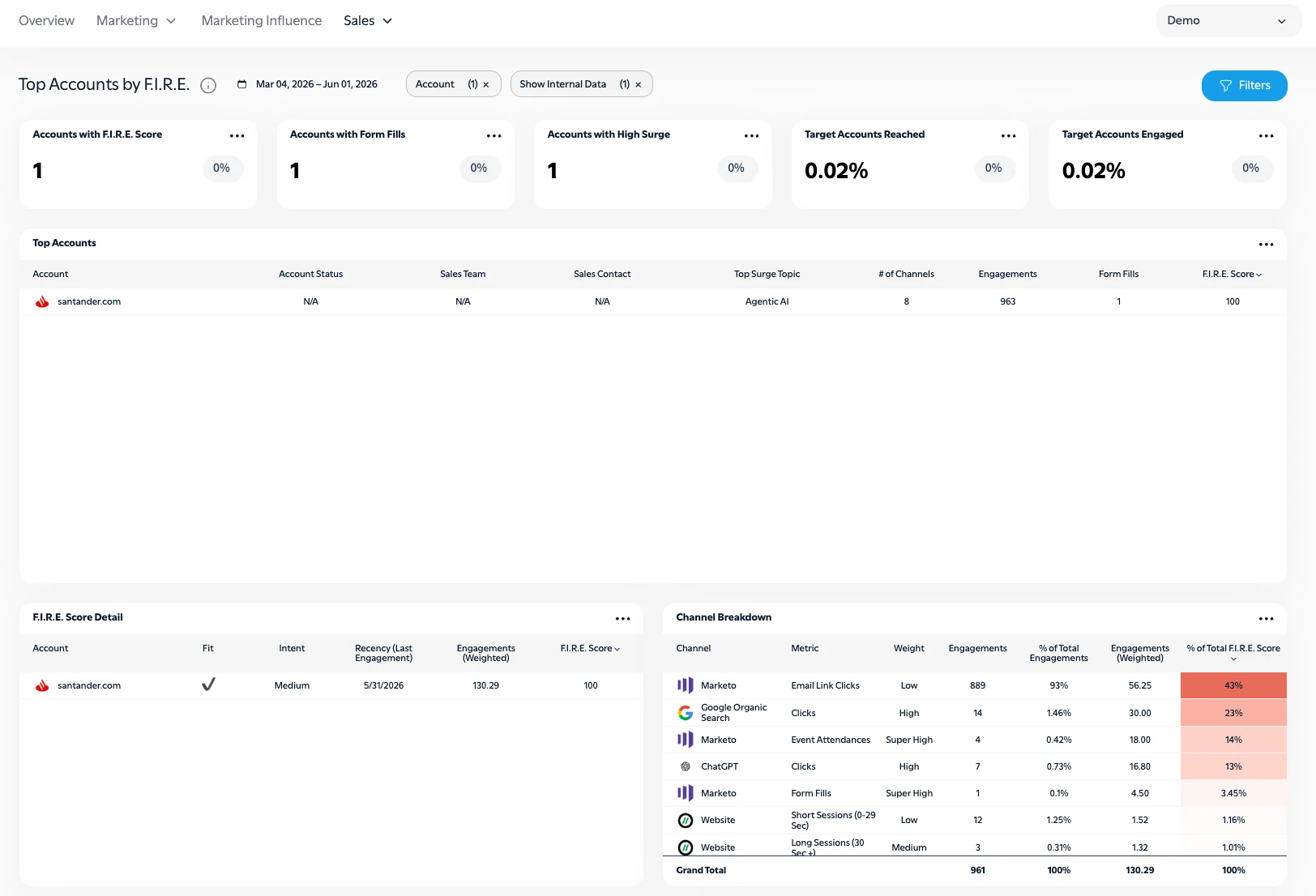
Octane11 Top Accounts by F.I.R.E. dashboard with the F.I.R.E. Score Detail panel showing Fit, Intent, Recency and weighted Engagements per account, beside a Channel Breakdown of what is driving each score
Top Accounts by F.I.R.E.: Fit, Intent, Recency and weighted Engagements are scored per account and rolled into a single 0–100 F.I.R.E. Score, recalculated as new signal comes in. The Channel Breakdown panel shows how much of each score a given channel is responsible for.

Through the Octane11 Website Tag, visits from Google Organic, ChatGPT, Perplexity and other referrers resolve to named accounts instead of showing up as an anonymous session, and the Channel Breakdown panel shows what share of an account's score each of those channels is carrying. For accounts doing heavy self-directed research, one organic channel can carry most of it.

The organic blind spot, on a real account

One recent example, from a top-priority target account tracked by an Octane11 client: organic search was driving 49 percent of that account's total F.I.R.E. Score, on the strength of 28 organic clicks the paid media plan never saw. On paid signal alone the account looked mid-tier. The organic view showed a company that had been quietly researching the category for weeks.

What this looks like on an actual account

Picture a typical enterprise account moving through evaluation. Ten people across finance and IT touch your brand over six weeks. Individually, none of them crosses a lead scoring threshold: a pricing page visit here, an AI search result there, one webinar registration.

Rolled up as a single account, the picture changes. Five buying group members visited the pricing page, most of that activity landing in the last two weeks, so recency works in the account's favor rather than against it. Two arrived through ChatGPT. The account is showing high intent on a topic tied directly to your category. Fit was already confirmed months ago.

That account should be at the top of the list this week. No individual lead score would have flagged it, because no one person carried enough of the signal alone.

That single number travels well because each role reads it differently. A rep sees the account to call this week, with the timeline of who looked at what already attached. A demand gen lead sees whether the channels in the plan are reaching real members of the buying group or just piling up clicks. For a CMO, it becomes a line in the board narrative that ties marketing to a named account and the pipeline behind it.

What this means for agencies reporting to clients

For agencies running the campaigns behind these accounts, the same rollup answers a question that's always been awkward to raise with a client: are we actually reaching the people who matter, or just generating activity that looks good in a deck?

A campaign report showing impressions and clicks doesn't tell a client whether five members of the target account's buying committee engaged, or whether the account is showing high intent on a topic tied directly to the pitch. F.I.R.E. Score does, at the account level, across every channel in the media plan — the difference between reporting that shows charts and reporting that answers questions. That turns a quarterly business review from a defense of spend into a walkthrough of which target accounts moved from unaware to actively researching, and why.

For the agency lead, that same view is what a renewal is built on. You can open the review with the named accounts the media plan actually reached, flag the ones showing high intent on a topic tied to the pitch, and show which climbed from unaware to actively researching over the quarter. It reads as strategy rather than activity. It also hands the client's own CMO something account-level to take to their board, and that's usually what keeps the account.

What account scoring won't fix

Account scoring solves the wrong-unit problem. It does not solve every problem, and it's worth being clear about where it stops before you expect it to do more than it can.

It tells you which account is in-market. It doesn't tell you which of those people to call first. You still need contact-level data and a rep who knows how to work a committee. A high account score is a reason to prioritize the account, not a script for the conversation.

It's also only as good as your definition of Fit. If your ICP is loose or out of date, the model will confidently rank accounts you were never going to close. Account scoring rewards teams that have done the unglamorous work of defining who they actually sell to, and it exposes teams that haven't.

And intent is directional, not proof. A high-intent topic and a cluster of organic visits mean an account is researching the category. They do not guarantee it's researching you, or that a deal is imminent. The value is in reallocating attention toward accounts worth a closer look, not in treating a score as a forecast.

See how F.I.R.E. Score ranks accounts

If any of this sounds closer to your last QBR or your last sales stand-up than you'd like, it helps to see account-level scoring in the product, not as a hypothetical.

Book a demo and we'll walk you through F.I.R.E. Score: Fit, Intent, Recency, and Engagement broken out at the account level, including the organic and AI search activity that lead-based reporting tends to miss.

This is what sales teams mean when they say they don't trust the lead list. The data itself is usually accurate. The unit of measurement is the problem. A committee doesn't buy one action at a time from one person. It buys as a group, over weeks, mostly out of view of any single vendor's tracking.

The operational fix

Sales teams that want to fix this shouldn't wait for a better MQL definition. The more useful shift is operational: review accounts on a standing weekly cadence, and watch which accounts climb week over week and which quietly go cold as the score recalculates. That single change moves the conversation from "here's a lead with a score" to "here's an account that's been researching this for three weeks and just visited pricing twice," and that's a conversation sales can actually act on.

The point isn't to build a better lead scoring model. It's to stop scoring leads and start scoring the accounts behind them. Octane11 builds that weekly account view directly into F.I.R.E. Score and the Account Detail page, so sales sees the full engagement history behind the number, not just the total.

Frequently asked questions

The questions sales and marketing leaders ask most about lead scoring, account scoring, and F.I.R.E. Score.

What is lead scoring, and why does it fail for B2B sales teams?

Lead scoring assigns point values to individual actions, like email opens or content downloads, and flags a person as sales-ready once they cross a threshold. It fails because B2B buying decisions are made by a group — Gartner's buyer-enablement research puts the median buying group at six to ten decision makers — and most scoring models never account for that group, or for the fact that points rarely decay once earned.

What's the difference between lead scoring and account scoring?

Lead scoring ranks individual people based on their own actions. Account scoring rolls up every signal from everyone at a company, across every channel, into a single score for that account. Account scoring reflects how B2B buying committees actually operate. Lead scoring reflects how one person interacted with your marketing.

What is the Octane11 F.I.R.E. Score?

F.I.R.E. Score is Octane11's account-level scoring model, combining Fit, Intent, Recency, and Engagement into a single 0-100 score that updates as new signal comes in. It tells sales which named accounts are showing the strongest combination of ICP fit and active, current buying behavior.

How does third-party intent data factor into account scoring?

Third-party intent data measures how much content an account is consuming on a given topic recently against that account's own historical baseline, and refreshes weekly. Octane11 feeds high-intent topics directly into the Intent component of F.I.R.E. Score, so sales can see not just that an account is showing intent, but which topic is driving it.

What does Recency measure in F.I.R.E. Score?

Recency is one of F.I.R.E. Score's four components. It weights the score toward an account's most recent behavior, so an account that started researching last week ranks above one that earned points eight months ago and went quiet. Traditional lead scoring rarely decays, which is why stale accounts keep sitting near the top of the list. Recency keeps the score tied to what the buying group is doing right now.

How many people are typically involved in a B2B buying decision?

Gartner's buyer-enablement research puts the median B2B buying group at six to ten decision makers, each bringing four to five pieces of independently gathered research into the group's evaluation. Those figures were first published by Gartner in 2018 and remain the most widely cited benchmark for buying-group size.

How does organic and AI search traffic affect account scoring?

Organic and AI-referred traffic, from sources like Google Organic, ChatGPT, and Perplexity, often represents the bulk of a buying group's self-directed research — the dark funnel of B2B buying — and it happens before any form fill. Octane11 resolves that traffic to named accounts as part of the Engagement component of F.I.R.E. Score, and for accounts doing heavy self-directed research it can end up carrying a large share of that account's total score.

How does account-level scoring help agencies report to clients?

It replaces impressions and clicks with a view of which target accounts actually engaged and how far along they are in evaluation. Instead of defending spend, an agency can show a client which named accounts moved from unaware to actively researching, which channels reached them, and why F.I.R.E. Score flagged them as a priority.

Stop scoring leads. Start scoring accounts.

A buying group scattered across ten people
looks like noise in a lead scoring tool.

In F.I.R.E. Score, it looks like one clear, prioritized account.

Book a demo and we'll walk you through F.I.R.E. Score: how it ranks accounts on Fit, Intent, Recency, and Engagement, and how sales uses that to decide who to prioritize.