An MQL counts one person's click. Your buyers move in committees. Here's how to build an account-stage funnel that measures the way B2B actually buys.
An account-stage funnel measures named accounts as they move through defined buying stages (Out of Focus, Unaware, In-Market, Marketing Engaged, and Sales Engaged) instead of counting individual MQLs. Because a B2B purchase is made by a buying group of six to ten people, reporting on accounts advancing between stages maps to revenue far better than a lead count does. The lead doesn't disappear; it becomes a person-level signal inside an account-level system.
You know the moment. The board deck says the team generated 847 MQLs last quarter, and someone asks how many became real pipeline. The honest answer is twelve deals across nine accounts, and most of those accounts had five or six people involved before anyone raised a hand. The MQL number wasn't wrong. It just answered a question nobody in that room cared about.
Here's the reframe worth sitting with: the problem isn't your lead scoring model. It's that you're still measuring individual leads when the purchase is made by a committee. An account-stage funnel fixes the unit of analysis. Instead of tracking one contact's latest click, you track where an entire account sits in its buying journey, and you report on accounts moving forward rather than leads piling up.
This is for the marketing leader who's tired of defending a lead number that doesn't map to revenue, and for the agency leader who has to explain to a skeptical client why "we drove 400 form fills" is not the same as "we moved your target accounts closer to a decision."
An account-stage funnel measures named accounts as they move through defined buying stages, instead of counting individual leads by their most recent action. The unit you report on is the account and its buying group, not the person.
A traditional MQL funnel treats every form fill as a discrete unit. One person downloads a guide, crosses a score threshold, becomes an MQL, and the funnel grows or shrinks with the count. The trouble is that a modern B2B purchase runs through a buying group, often six to ten people across marketing, procurement, and the line of business, and those people rarely convert in a tidy sequence. Some never fill out a form at all, and much of the buying happens before anyone raises a hand. One of the sharpest things we hear in evaluations is a leader admitting they have no scoring signal to speak of and are, in their words, "flying blind" on which accounts are real. Counting leads harder won't solve that. Changing what you count will.
An account-stage funnel swaps the lead count for a set of stages every account passes through. A workable set looks like this:
| Stage | What it means | What you'd expect to see |
|---|---|---|
| Out of Focus | Not on your target account list | No investment, filtered out of reporting |
| Unaware | In your ICP, no meaningful exposure yet | Cold. The job is first-touch reach |
| In-Market | Showing research or intent signals | Rising engagement, high-intent topics, repeat visits |
| Marketing Engaged | The buying group is actively interacting | Multiple people, multiple channels, sustained activity |
| Sales Engaged | Sales is in active conversation | Meetings, opportunities, pipeline |
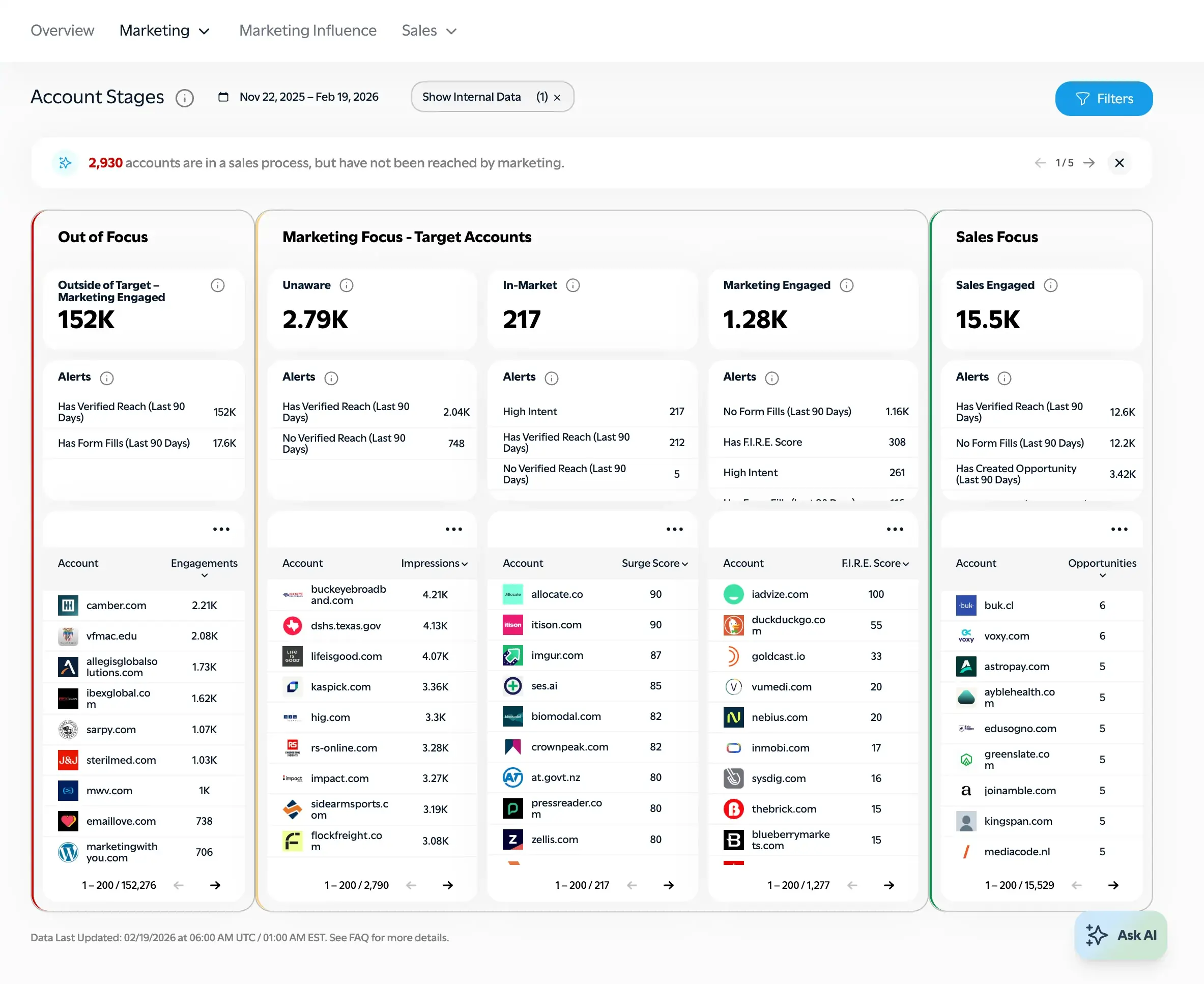
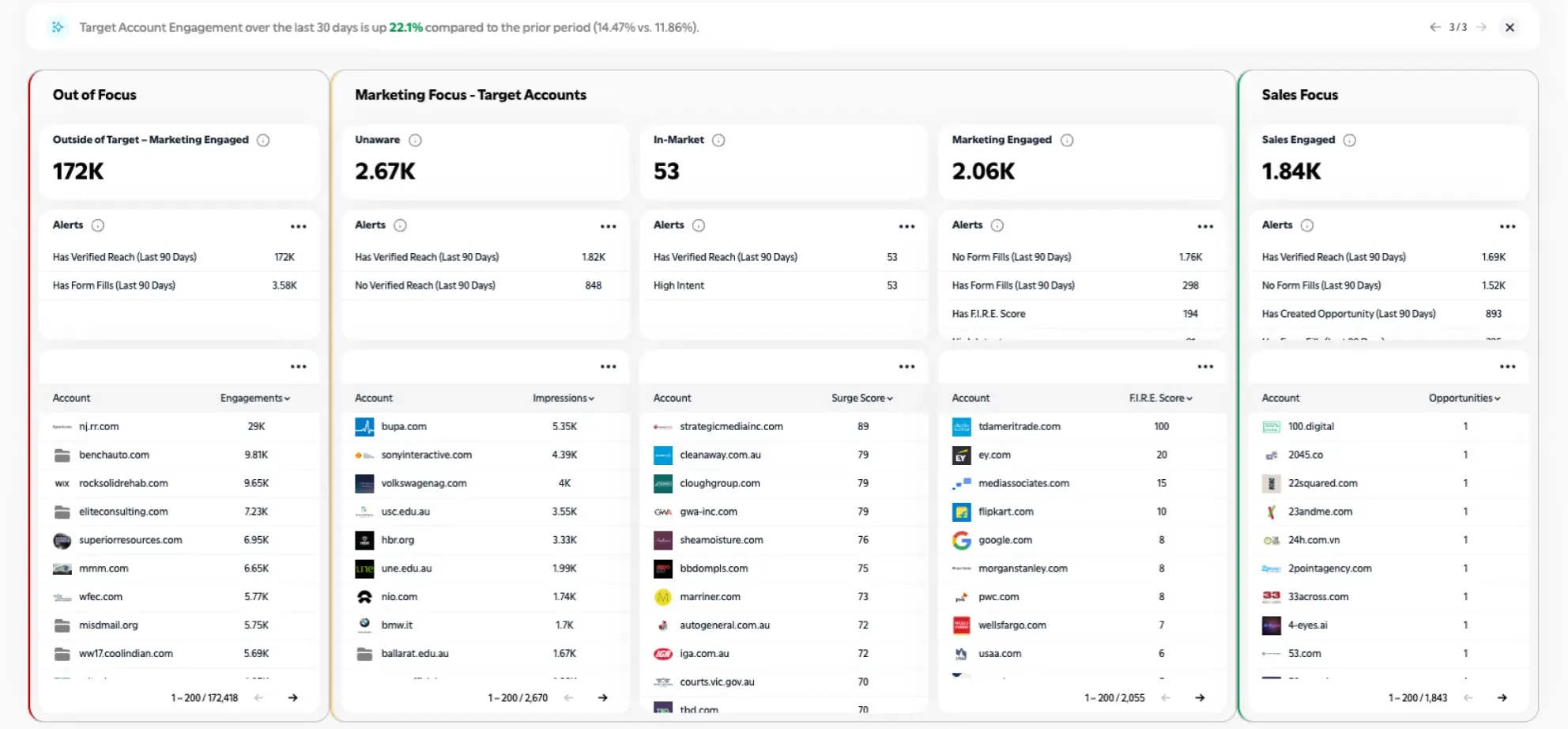
The labels aren't the point. The point is that you can now place every target account somewhere on this map and report on movement between stages as your headline metric. A quarter where forty accounts moved from Unaware to In-Market is a real story about demand creation. A quarter of 847 MQLs is a story about form design.
The MQL funnel fails because it optimizes for the wrong unit, and everything downstream inherits the error. Three failures show up again and again.
The first is the pipeline disconnect. When you measure success in leads, the number can climb while revenue stays flat, because a rising lead count can come from non-ICP traffic, a well-placed content offer, or one motivated person at an account that will never buy. Across our own platform data, spanning more than $100M in B2B media spend and 150-plus enterprise accounts, the accounts that close almost never look like a single hot lead. They look like a buying group that warmed up across several channels over months.
| What you measure | MQL funnel | Account-stage funnel |
|---|---|---|
| Unit of analysis | The individual lead | The named account and its buying group |
| Headline metric | Lead volume by latest action | Accounts advancing between stages |
| Signal it reads | One person's most recent click | Multi-person, multi-channel activity over time |
| What it optimizes for | Form fills | Accounts moving toward a decision |
| Board question it answers | How many leads did we generate? | How many target accounts moved forward? |
A funnel that can't see the group can't see the deal forming.
Why can't most funnels see the group? Because the signal is scattered across paid, owned, and organic channels and the CRM, and every system reports only its own slice. Tying all of it back to one named account is the hard part, and it's the part that makes an account-stage funnel possible in the first place.
The second failure is the messaging mismatch. When your unit is the lead, you tailor outreach to one person's last action. When your unit is the account, you can speak to the account's actual reality, which is what a committee sale demands. An account sitting in Unaware needs a very different message than an account where four people are already Marketing Engaged. Lead scoring flattens that into a single number and throws away the context that would tell you what to send next.
The third is the resourcing tax. Teams paper over the lead funnel's blind spots with manual work. We hear the same confession constantly: reporting held together with spreadsheets and lookups, rebuilt by hand every month, usually after hours because it isn't anyone's real job. An account-stage funnel doesn't just measure better. It removes the reason the manual reconciliation ever existed, because the account view is the reconciliation.
There's a fourth reason the MQL persists, and it has nothing to do with measurement. Plenty of demand gen teams are compensated on the very lead number they're being asked to walk away from, and nobody changes the metric they're paid on without friction. It's worth naming out loud, because the move to accounts is as much an incentives conversation as a reporting one. The teams that make the switch cleanly are usually the ones where the CMO reset the number the team is measured on at the same time they reset the funnel.
This topic gets forwarded around an account, so it helps to name what each reader gets.
For the CMO, it's the first version of the funnel you can put in front of the board without a footnote. You report how many target accounts advanced, and marketing's contribution reads in the language the C-suite already speaks: accounts and pipeline, not leads and scores.
For the demand gen and ABM leader, it changes how you plan. You can see which accounts are stuck in Unaware and need reach, which are In-Market and need acceleration, and which are Marketing Engaged and ready for sales. Budget follows the stage, not the campaign.
For the head of sales, it's a prioritization signal. Instead of a queue of MQLs with no context, the team sees which accounts have a buying group warming up across channels, which is the difference between a call worth making and a call that goes nowhere.
For the agency leader, it changes the client conversation from activity to progress, and it fits whichever kind of shop you run. If you deliver a managed reporting layer, the stage view becomes the client-ready proof that account movement, not impressions, is what your work produced. If you keep your own data pipeline and just want an account-level layer on top, the stage model is something you add without handing over control of your data. Either way, the client who keeps asking whether you're reaching their target accounts or just a big audience finally gets an answer framed as accounts advancing. That's a renewal conversation.
You can stand up a credible account-stage funnel in phases, and you should, because trying to perfect it before launch is how these projects stall.
Here's the inconvenient truth: moving beyond the MQL does not mean abandoning person-level detail, and anyone who tells you accounts are all that matter is overcorrecting.
Once an account is engaged, you need to know who inside it is engaged, because you can't influence a purchase decision without knowing who sits on the committee. As one operator put it to us, it's great to see things at the account level, but when you're figuring out who the real influencers are in the purchase, you need it at the person level. The account is the right unit for measuring your funnel and reporting to leadership. The buying group inside the account is the right unit for running the play. A mature setup holds both, treating the account stage as the frame and the people inside it as the detail. If a tool forces you to choose, it isn't ready for how committees actually buy.
The category is shifting from lead volume to account progression, and the teams that build an account-stage funnel early buy themselves two years of clearer reporting and calmer budget conversations before it becomes table stakes.
The lead won't disappear. It'll settle into its right role as a person-level signal inside an account-level system, instead of the number the whole business gets judged by.
Octane11 was built for the account-level version of this. It ties activity across your paid, owned, and organic channels and your CRM to named accounts and shows them moving through stages from Unaware to Sales Engaged, so the funnel your team runs on and the funnel you show the board are the same funnel. That's what lets teams stop reporting lead volume and start pointing budget at the accounts actually moving toward a decision.
See where your target accounts sit today, and which ones are advancing, so your next dollar goes to accounts on the move instead of a lead count that stops at the boardroom door.
The questions marketing and revenue leaders ask most about moving from an MQL funnel to an account-stage funnel.
An account-stage funnel measures named accounts as they move through defined buying stages, such as Unaware, In-Market, Marketing Engaged, and Sales Engaged. It replaces the lead count with account progression as the primary metric, which matches how B2B purchases are actually made by buying groups rather than individuals.
An MQL funnel counts individual leads by their most recent action. An account-stage funnel tracks where a whole account and its buying group sit in the purchase journey. The first optimizes for form fills, the second for accounts advancing toward a decision.
No. Leads and person-level signals still matter, especially once an account is engaged and you need to know who's on the buying committee. The shift is about which unit you report on and manage the funnel by. The account becomes the frame, and the people inside it become the detail.
A common set is Out of Focus, Unaware, In-Market, Marketing Engaged, and Sales Engaged. The exact labels matter less than agreeing on clear entry criteria for each stage so your team and any outside partners place accounts consistently.
A B2B purchase usually involves six to ten people across several functions. Because those people rarely convert in sequence and some never fill out a form, measuring individual leads misses most of the real buying activity. Measuring at the account level captures the group's collective progress.
You need a defined target account list, signals that place accounts in stages (campaign exposure across channels, website visits, third-party intent data), and CRM activity for the sales-engaged stages. The aim is for accounts to land in a stage automatically from real activity rather than manual sorting.
Yes. For agency leaders it reframes client reporting from activity to progress, showing how a client's target accounts advanced through buying stages rather than how many impressions or form fills a campaign produced, which supports renewals and upsells.
Forty accounts advancing from Unaware to In-Market is a story about demand.
In a demo, see how Octane11 ties activity across paid, owned, and organic channels and your CRM to named accounts, and places each one on a stage map from Unaware to Sales Engaged, so the funnel your team runs on and the funnel you show the board are the same funnel.